Influence. Relevance. Growth.
You delivered.
The stock didn’t notice.
IRG helps CEOs measure the gap between operational achievement and market recognition, estimate the value already created but not fully recognized, and act on the factors within their control.
Research-grounded. AI-enabled. CEO-led.

Value created. Not always recorded—or recognized.
92%
of S&P 500 market capitalization was attributable to intangible assets at year-end 2025
Forbes (2025)
Investors already value expected future performance. The question is whether they have sufficient evidence to understand the capabilities supporting it.
Under US GAAP, many internally developed intangibles are expensed rather than recognized as balance-sheet assets. IFRS expenses research and capitalises development only when strict criteria are met.

IRG examines the passage from industrial achievement to market recognition, focusing on capabilities already built—not simply on expected future delivery.
IRG is the CEO’s new discipline for capturing intangible value.
It is an AI-powered semantic intelligence system that measures how well a company converts what it knows and does into influence, trust, and market capitalization.
It gives CEO’s a data-driven infrastructure for understanding where value is being left on the table, and what to do next.

Value is created or destroyed
in the minds of others.
IRG organises the path to value capture into five stages:
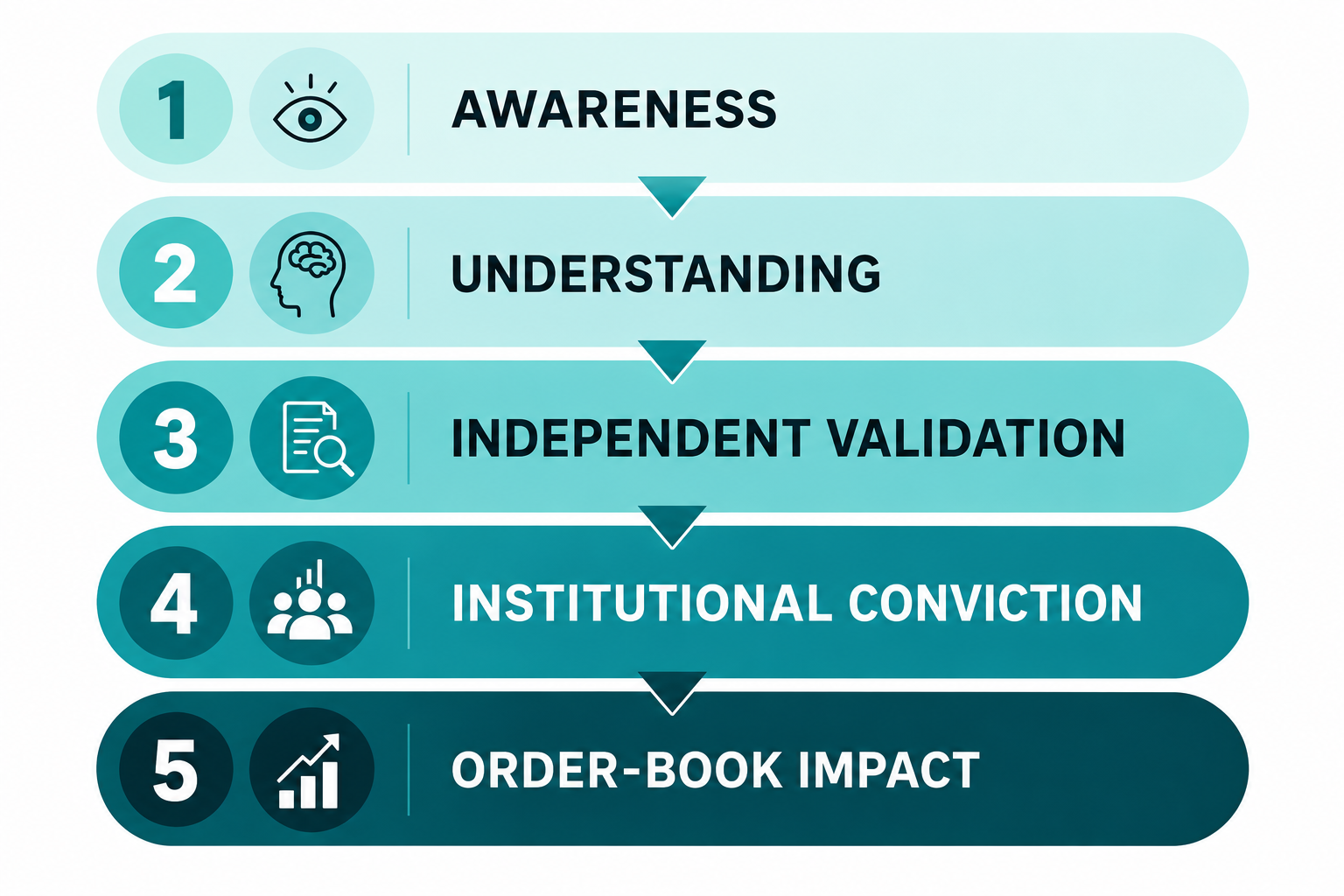
The path crosses investor relations, communications, strategy and marketing, yet often lacks a single end-to-end owner.
Like marketing alongside sales, IRG complements existing functions without replacing them.
IRG—Influence, Relevance, Growth—connects industrial achievement with market recognition.
It gives CEOs one number, one estimate of potentially unrecognised value and one plan to act.
A discipline—not another score.
Re-rating is the goal, not a guarantee.
It is time for companies to own this process end to end.

Where traditional tools can only look backwards at what has already happened, IRG establishes the capability to shape what happens next.

What IRG Gives You:
One number.
One locked-value estimate.
One action plan.
A number:
Your company and relevant peers assessed on ten publicly observable parameters, with a total from 0 to 30.
A locked-value estimate:
The constraint mechanism combines the assessment with industry-specific financial comparisons to estimate value already created but potentially unrecognised. This is a model-based estimate—not a guaranteed valuation uplift.
A plan:
A CEO-led 90-day market test, followed by scale-up, with stock re-rating as the goal.
Ten Parameters.
One Number.
Influence — the strength of the business: governance, industry leadership, financial influence, social responsibility and human capital.
Relevance — its outward leadership: industry power, innovation excellence, world citizenship, media power and thought leadership.
Growth — the financial and industrial-policy objective: stronger market recognition and better-informed stakeholders.
Traditional Dimensions of Business Success
- 01Company Governance
- 02Industry Leadership
- 03Financial Influence
- 04Social Responsibility
- 05Human Capital
Modern Dimensions of Future Power
- 06Industry Power
- 07Innovation Excellence
- 08World Citizenship
- 09Media Power
- 10Thought Leadership
The Evidence:
Average IRG number: 13.78 out of 30.
Companies can perform strongly while leaving important value drivers insufficiently visible to investors. Markets assess both current performance and future expectations.
The Triad averages 38% of its available scoring range. This is an assessment result—not a measure of economic value unlocked or management intent.

365 companies. Approximately $60 trillion in market capitalisation.
The Triad
Industry Power: Shape the sector’s debate.
Media Power: Make industrial value visible and understandable.
Thought Leadership: Establish the ideas through which the company is understood.

IRG assesses where these levers may help close a recognition gap — and identifies what management can test.

The 90-day test:
IRG is a CEO-led intervention in how investors understand the company.
The goal is to give management a sustained voice in shaping the company’s investment narrative—not merely responding to it.
The mechanism is a CEO-led, company-owned channel that makes industrial capabilities visible and tests which evidence-backed messages resonate with the targeted audience. The output is a ranked set of messages based on observed responses.
Scale-up builds on these findings to pursue independent validation, broader institutional interest and, ultimately, stock re-rating. Message engagement alone does not establish investor conviction or a share-price effect.
Built On Research:
Established science.
An integrated discipline.
IRG assembles seven research traditions into a practical system for the CEO.
Its research agenda is advanced through the IRG CEO Monitor at SDA Bocconi School of Management.
U.S. patent application pending.
The Observatory:
Ideas.
Evidence.
Action.
Explore the recognition gap, examine the global findings and discover how a company-specific assessment can become a management starting point.
Article Examples:
You delivered. Did the market understand?
365 companies. A recognition gap worth investigating.
Your company is not an average. Start with its recognition gap.



The IRG Conference.
The IRG Conference Series is a collaboration between IRG, Aspen US, Aspen Italia, CNBC, Class CNBC, and SDA Bocconi School of Business.
Find out what investors may be missing.
Start with a confidential conversation about your company’s market recognition and the next steps worth investigating.